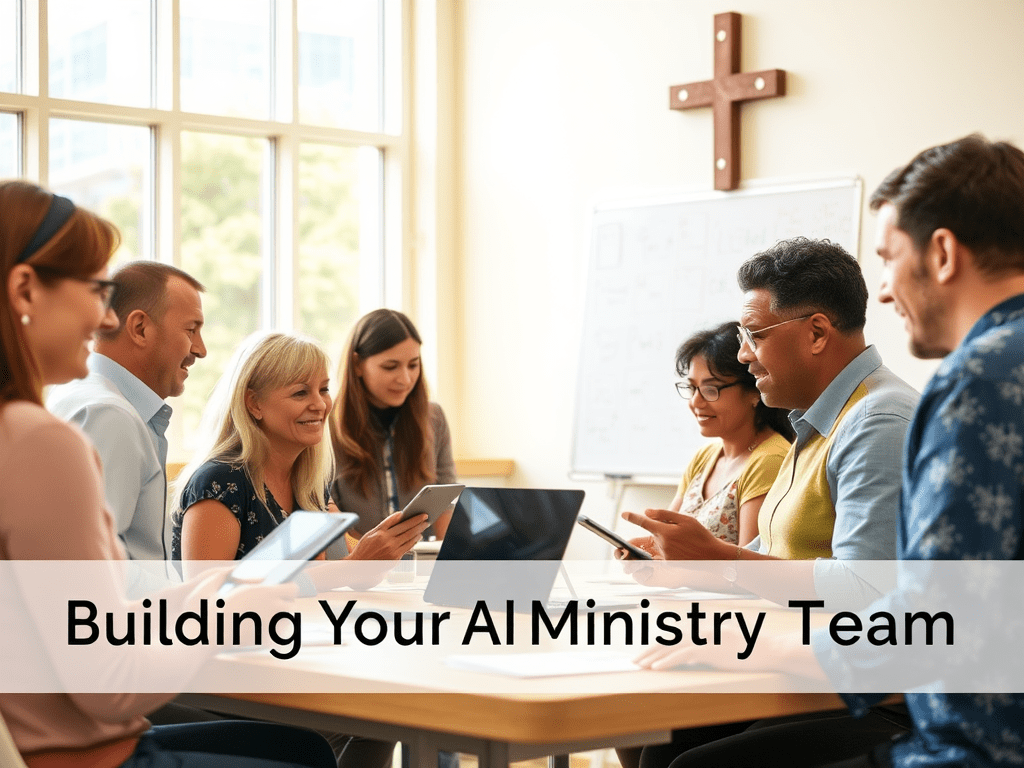
Successful AI integration in ministry requires more than individual pastoral competence—it needs congregational engagement. Building an AI-equipped ministry team involves training, empowerment, and cultural change. Here’s how to move from solo experimentation to congregational transformation, ensuring technology serves the whole body of Christ rather than creating digital divisions.
Begin with a small coalition of the willing. Identify 3-5 individuals who combine technological curiosity with ministry passion: “Select team members for an AI exploration group: someone comfortable with technology, a skeptic with valid concerns, a creative ministry leader, someone representing older generations, and a youth perspective.” Diverse perspectives prevent blind spots.
Create a learning laboratory environment: “Design a six-week exploration phase where team members: experiment with AI tools without pressure, share discoveries and failures openly, discuss theological implications together, and discern appropriate applications for our context.” Safe experimentation builds confidence.
Start with low-risk, high-value applications. Choose initial projects that demonstrate value without threatening core ministries: “Identify three pilot projects for AI assistance: newsletter content that requires editing anyway, Bible study questions for leader preparation, and event planning templates for repeated activities.” Early wins build momentum.
Develop shared theological understanding: “Lead a study series on technology and faith covering: biblical perspectives on human creativity, Wesleyan theology of means of grace, historical Methodist innovation, and ethical boundaries for AI use. Include discussion and prayer.” Theological grounding guides practical decisions.
Create role-specific training paths. Different ministries need different AI applications: “Develop training modules for: worship leaders (liturgy and creative elements), education coordinators (curriculum and activities), administrative staff (communication and organization), and care team members (appropriate boundaries).” Targeted training increases relevance.
Address generational differences constructively: “Bridge the digital divide with paired learning: tech-comfortable youth teaching basics to older adults, experienced ministers sharing pastoral wisdom with digital natives, and middle generations facilitating between both.” Mutual learning builds community.
Establish clear policies before problems arise: “Create an AI use agreement covering: appropriate uses for different information types, attribution and transparency requirements, review processes for AI-generated content, and accountability structures.” Proactive policies prevent problems.
Build incremental competence through progression: Month 1: Basic tool familiarity and simple prompts. Month 2: Applied experiments in ministry contexts. Month 3: Collaborative projects and shared learning. Month 4: Policy development and boundary setting. Month 5: Broader rollout with support systems. Month 6: Evaluation and adjustment.
Create support systems for ongoing learning: “Establish multiple support channels: weekly office hours for questions, buddy systems pairing experienced with new users, shared document libraries of successful prompts, and regular celebration of creative applications.” Sustained support ensures adoption.
Address resistance with empathy and evidence: “Common concerns include: job replacement fears, theological objections, privacy worries, and complexity overwhelm. For each concern, provide: empathetic acknowledgment, factual information, practical safeguards, and gradual exposure.” Patient response overcomes resistance.
Develop ministry-wide coordination: “Create systems ensuring AI enhancement across ministries: shared prompt libraries everyone can access, coordinated training schedules, cross-ministry collaboration opportunities, and regular sharing of best practices.” Integration prevents silos.
Enable volunteer multiplication through AI: “Show volunteers how AI can expand their impact: Sunday school teachers creating diverse activities, committee members drafting better reports, greeters personalizing welcome messages, and musicians finding new resources.” Empowered volunteers strengthen ministry.
Create feedback loops for continuous improvement: “Implement regular review cycles: monthly team debriefs on what’s working, quarterly congregational surveys on AI impact, annual policy and practice reviews, and ongoing theological reflection.” Continuous improvement ensures faithfulness.
Share leadership to prevent dependence: “Distribute AI expertise across multiple people: avoid single points of failure, create succession plans for key roles, document processes clearly, and rotate responsibilities regularly.” Shared leadership ensures sustainability.
Connect with broader learning communities: “Join networks of churches exploring AI: denominational technology groups, ecumenical learning cohorts, online ministry forums, and regional partnerships.” External connections accelerate learning.
Measure transformation, not just adoption: “Track meaningful metrics: increased volunteer engagement, improved ministry quality, time redirected to pastoral care, and spiritual growth indicators. Include stories alongside statistics.” Kingdom metrics matter most.
Celebrate appropriate innovation while honoring tradition: “Create rituals that honor both: blessing of technology for ministry use, testimony times for transformation through digital tools, integration of AI insights in traditional practices, and celebration of human creativity enabled by AI.” Balance honors all generations.
Develop contingency plans for potential problems: “Prepare for challenges: key volunteer leaving with all AI knowledge, data breach requiring response, AI platform becoming unavailable, and congregation member objecting to AI use.” Preparedness prevents panic.
Foster theological reflection throughout adoption: “Maintain ongoing discernment: How is AI affecting our community life? Where do we see spiritual fruit? What unexpected challenges arose? How is God working through this technology?” Reflection ensures faithful implementation.
Create documentation for institutional memory: “Build a comprehensive record: successful implementations and why they worked, failed experiments and lessons learned, policy decisions and their rationale, and training materials for new members.” Documentation serves future leaders.
Remember the goal isn’t technological sophistication but ministry effectiveness. Some congregations will embrace AI enthusiastically; others will adopt slowly and selectively. Both approaches can be faithful if they serve the mission of making disciples and transforming the world.
Best practices for team building include starting small and expanding gradually, celebrating early adopters without pressuring reluctant members, maintaining focus on ministry over technology, ensuring no one is left behind, and regularly returning to theological foundations.
Share your team’s journey with other congregations. What worked in your context? What challenges did you face? How did different groups respond? This transparency helps the broader church learn from diverse experiences.
The transition from individual to congregational AI use mirrors other transformations in church life—it requires patience, persistence, and grace. When technology serves the entire body of Christ, enabling each member to use their gifts more effectively, it fulfills its proper purpose in ministry.
This post was developed in collaboration with Claude (Anthropic) as part of a series exploring the intersection of artificial intelligence and Wesleyan ministry.
Also in this series:
- The Grace That Goes Before: Why Wesleyan Theology Embraces Innovation
- From Field Preaching to AI: A Methodist History of Innovation
- The Quadrilateral Guide: Evaluating AI Through Scripture, Tradition, Reason, and Experience
- Christian Perfection as Our Digital North Star
- Your First Steps with AI: Free Tools Every Pastor Should Try
- The Art of the Prompt: Speaking AI’s Language for Ministry
- AI-Enhanced Sermon Preparation: A Practical Workflow
- From Exegesis to Application: AI Tools for Biblical Study
- Digital Discipleship: Enhancing Class Meetings for the 21st Century
- The Means of Grace in Digital Space
- Beyond Sunday Morning: AI for Weekly Ministry Rhythms
- Small Church, Big Impact: AI Solutions for Limited Resources
- Social Holiness in Action: AI for Justice Ministry
- Extending Grace: AI-Powered Evangelism and Outreach
- The Human Touch: What AI Can Never Replace in Ministry
- Digital Trust: Privacy, Confidentiality, and Data Stewardship

 Rev. Andrew Conard
One reply on “Building Your AI Ministry Team: From Individual to Congregation”
[…] Building Your AI Ministry Team: From Individual to Congregation […]