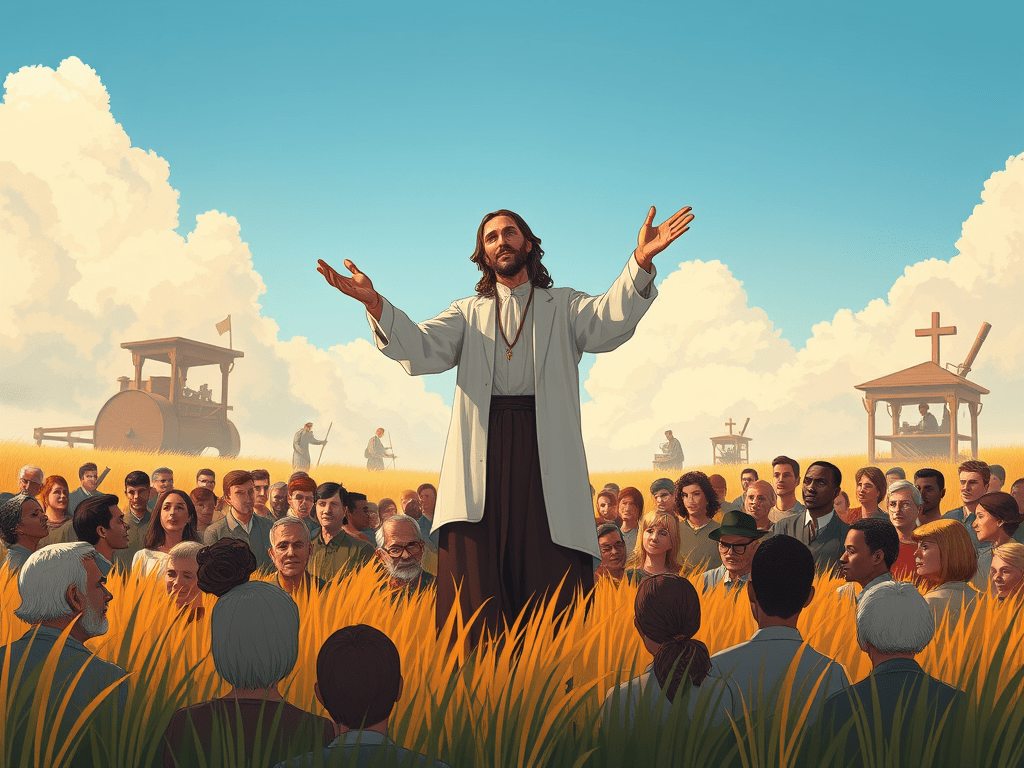
The Methodist movement has always been marked by innovative approaches to spreading the Gospel. From its earliest days, Methodists have embraced new technologies and methods when they served the mission of making disciples. This heritage of holy innovation provides both precedent and wisdom for today’s engagement with artificial intelligence.
John Wesley’s decision to preach in fields wasn’t just circumstantial—it was revolutionary. When Anglican churches closed their pulpits to his message of free grace and holy living, Wesley took to the open air. This wasn’t merely a practical solution but a theological statement: the Gospel couldn’t be contained within traditional structures. By 1739, he was regularly preaching to thousands in fields and marketplaces, reaching coal miners, factory workers, and others whom the established church had forgotten.
The printing press became Wesley’s force multiplier. He published over 400 works during his lifetime, including sermons, hymns, theological treatises, and practical guides for Christian living. His penny pamphlets made theological education accessible to common people. The Methodist publishing house, established in 1789, became one of the largest publishers in America by the mid-1800s. Wesley understood that technology could democratize spiritual knowledge and extend ministry beyond physical presence.
Perhaps Wesley’s greatest innovation was the class meeting—small groups of twelve people who met weekly for mutual accountability and spiritual growth. This wasn’t just organizational genius; it was technological innovation for its time. The class meeting system created a scalable, reproducible method for spiritual formation that could function with minimal pastoral oversight. Leaders were equipped with specific questions to ask, creating what we might today call a “spiritual algorithm” for growth in grace.
The circuit riding system represents another Methodist innovation that maximized limited resources through systematic organization. Circuit riders covered vast territories on horseback, bringing sacraments, preaching, and pastoral care to scattered frontier communities. They carried portable libraries in their saddlebags, functioning as mobile information networks long before the internet. Francis Asbury, American Methodism’s founding bishop, traveled an estimated 270,000 miles on horseback, demonstrating how technology (even simple technology like improved saddles and road systems) could extend ministry reach.
Methodist innovation continued through the centuries. The Sunday School movement, which Methodists enthusiastically adopted and adapted, used new educational technologies like blackboards, maps, and graded curriculum. The camp meeting tradition created temporary sacred spaces that combined revival preaching with social networking—a 19th-century version of conference centers that brought isolated believers together for intensive spiritual formation.
In the 20th century, Methodists embraced radio and television for ministry. The Protestant Hour radio program, launched in 1938, reached millions with Gospel messages. Later, television programs like “Talk Back” addressed contemporary issues from a faith perspective. These weren’t just adoptions of secular technology but creative adaptations that maintained Methodist theological distinctives while using new media.
The rise of the internet found Methodists again at the forefront. The United Methodist Church launched one of the first denominational websites in 1995. Online education through Course of Study programs made theological education accessible to bi-vocational pastors. Digital archives preserved Methodist heritage while making historical resources globally available. Video conferencing enabled connectionalism across vast distances, maintaining organizational unity while reducing travel costs and environmental impact.
Each technological adoption followed similar patterns that offer wisdom for AI integration. First, there was initial resistance from traditionalists who feared change would compromise theological integrity. Second, pioneers demonstrated how new tools could serve traditional goals. Third, best practices emerged through experimentation and evaluation. Fourth, the technology became normalized as its benefits proved themselves through spiritual fruit.
What’s striking about Methodist technological adoption is the consistent evaluation criterion: does this innovation help spread scriptural holiness? Technologies that passed this test were embraced enthusiastically. Those that didn’t were modified or abandoned. The theological principle remained constant while methods evolved.
This history suggests several principles for AI adoption. Innovation should serve mission, not drive it. New technologies work best when they enhance rather than replace human relationships. Accessibility and democratization matter—tools should empower the many, not just the few. Evaluation should focus on spiritual transformation rather than institutional metrics.
The Methodist tradition of holy innovation also warns against common pitfalls. Technology can become an idol when efficiency matters more than effectiveness. Innovation can create division when early adopters move too fast for their communities. New tools can inadvertently exclude those without access or skills. These historical lessons remind us to implement AI thoughtfully, inclusively, and always in service of love.
Today’s AI tools represent another opportunity in this long tradition of Methodist innovation. Like field preaching, they take the Gospel where people are—digital spaces where millions spend their time. Like the printing press, they democratize access to theological resources. Like class meetings, they can facilitate accountability and spiritual growth. Like circuit riding, they extend ministry reach beyond physical limitations.
The question isn’t whether Methodists should use AI—our history suggests we will and should. The question is how we’ll use these tools faithfully, maintaining our theological commitments while embracing new possibilities for transformation. Our ancestors in faith show us the way: bold innovation coupled with careful evaluation, always measuring success by growth in perfect love.
This post was developed in collaboration with Claude (Anthropic) as part of a series exploring the intersection of artificial intelligence and Wesleyan ministry.
Also in this series:

 Rev. Andrew Conard
16 replies on “From Field Preaching to AI: A Methodist History of Innovation”
[…] From Field Preaching to AI: A Methodist History of Innovation […]
[…] From Field Preaching to AI: A Methodist History of Innovation […]
[…] From Field Preaching to AI: A Methodist History of Innovation […]
[…] From Field Preaching to AI: A Methodist History of Innovation […]
[…] From Field Preaching to AI: A Methodist History of Innovation […]
[…] From Field Preaching to AI: A Methodist History of Innovation […]
[…] From Field Preaching to AI: A Methodist History of Innovation […]
[…] From Field Preaching to AI: A Methodist History of Innovation […]
[…] From Field Preaching to AI: A Methodist History of Innovation […]
[…] From Field Preaching to AI: A Methodist History of Innovation […]
[…] From Field Preaching to AI: A Methodist History of Innovation […]
[…] From Field Preaching to AI: A Methodist History of Innovation […]
[…] From Field Preaching to AI: A Methodist History of Innovation […]
[…] From Field Preaching to AI: A Methodist History of Innovation […]
[…] From Field Preaching to AI: A Methodist History of Innovation […]
[…] From Field Preaching to AI: A Methodist History of Innovation […]