

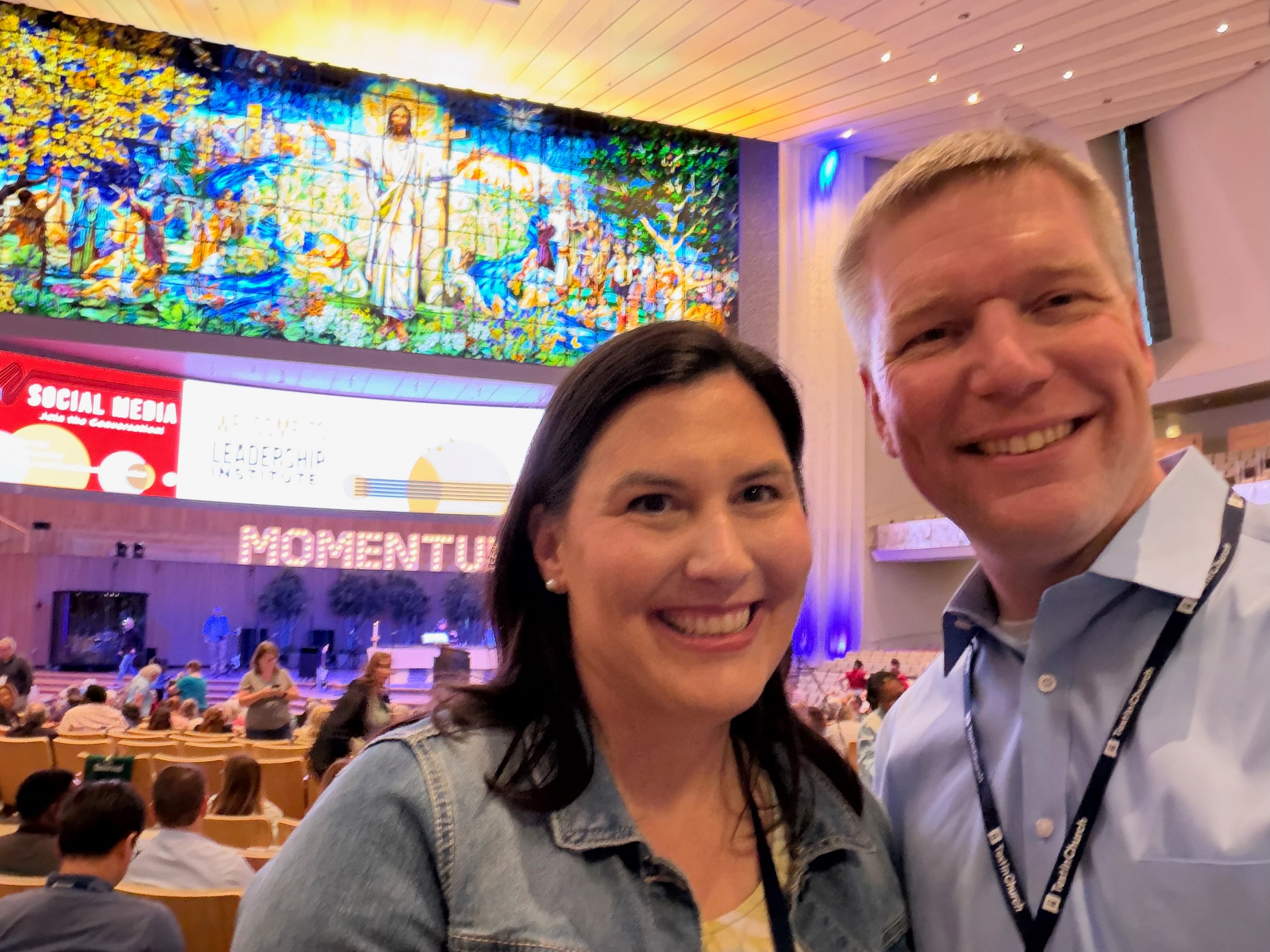
Notes from Resurrection is a short mini-series from Leadership Institute 2026 at Resurrection, A United Methodist Church, in Leawood, Kansas. A post goes up for each day. These are observation, not transcript.
Back at Resurrection
Nicole and I drove over Wednesday in the rain. We got to Resurrection just in time for the opening session. As we walked in from the parking lot, people remembered us from our years on staff. It was almost a surprise. Nicole and I began our ministry careers here, serving in several roles from 2006 to 2012. Seeing those friends was an unexpected gift. It is one of the best things about coming in person. On the breaks, we see people we have known for a long time. These relationships are life-giving.
Kansas, Town by Town
The first general session began with a time of music, song, and worship. Then Adam Hamilton shared stories from the Kansas campaign trail. He drew a lesson for the church from each stop.
Hamilton’s campaign stop at McCarty Family Farms, a dairy in Rexford, became a lesson about manure. On a dairy, managing it is part of every day’s work. A church has to manage it too, because every leader has some to deal with. When it piles up, it can wear a leader down. Anyone who has felt like quitting is in good company, including Moses and Elijah. Hamilton pointed us to the psalms of lament and to Isaiah’s promise of hope: “a crown in place of ashes” (Isaiah 61:3).
Lebanon sits near the geographic center of the lower 48 states. Its small U.S. Center Chapel was the setting for “The Middle,” a 2021 Jeep ad with Bruce Springsteen. Hamilton held up that chapel as a picture of the church as a healer of division. Methodism has long seen itself as a middle way. It holds together things others pull apart, like personal faith and social holiness, or head and heart. On many questions, we may not have to pick a side.
Cawker City is home to the big ball of twine. People come there to see that one thing. Hamilton turned it into a question for our churches: what is the one thing people come to see? That question sounds a lot like The Advantage, the book we have been reading together. Patrick Lencioni asks how an organization will succeed. His answer is a few strategic anchors, the handful of things that set it apart. In a way, those anchors are a church’s ball of twine.
In Clay Center, Hamilton told the story of Clay Center UMC and its incredible growth under the leadership of its pastor, the Rev. Dr. Reuben Langat. Hamilton shared a video of the church’s life, with congregants and an interview with Pastor Reuben. His ministry starts with loving the people. That love reaches past the church doors to the whole town. As Pastor Reuben puts it: “If I am a pastor in this community, I need to love the community.”
Monument Rocks is a set of chalk formations on the prairie in Gove County. It is out of the way, so getting there takes time, and you have to mean to go. Once you arrive, you have the opportunity to slow down and look around. Hamilton made that the lesson for church leaders. A good bit of ministry is paying attention, and that means slowing down. Like the drive to Monument Rocks, it takes intention.
In Hutchinson, the stop was the State Fair debate. The lesson came from Jesus: “You are the salt of the earth” (Matthew 5:13). Salt mines run deep under and near Hutchinson, just down the road from McPherson. Before the debate, the Rev. Shelly Petz gave Hamilton a piece of that salt, and he kept it on the podium with him. Separately, we were given a piece of salt on the way out of the session. Salt preserves, heals, and gives flavor. It even gives us the word salary.
Bringing It Home to McPherson First
Hamilton’s stories were about places all over Kansas, but each stop raises questions worth asking here in McPherson.
Rexford: Every congregation has some manure to manage, including ours. Where is it in our life together? Are we managing it well? Who among us is worn down right now, and how can we help carry it?
Lebanon: McPherson has its divisions, like every town. A Methodist church can be a place where people who disagree still sit together. Where can we help heal division here? What do we need to hold together?
Cawker City: Every church is known for something. What is the one thing people come to see or be a part of at McPherson First UMC? What would we want it to be?
Clay Center: We are called to love all of McPherson, not only the people in our pews. What would that look like this month?
Monument Rocks: Paying attention to our neighbors won’t happen by accident. Where do we need to slow down? What is worth the extra effort?
Hutchinson: Salt preserves, heals, and gives flavor. Which of those does someone you know need right now? What is one thing you can do for them this week?
These questions are for all of us. They work wherever you live and whatever church you call home. Pick one and talk it over with someone this week, at church, at home, or over coffee. More to come from Day 2.