

Notes from Kearney is a short mini-series during the 2026 Great Plains Annual Conference. Posts go up each morning of the conference. These are observation, not transcript.
An Honest Day
I will be honest. Friday turned into a harder day for me than the ones before it. It carried the bulk of our work, the long stretch of reports and business, and somewhere in the middle of it a weight settled in. Nothing I can point to exactly, more an awareness of how much road the church still has ahead.
We have a word for that. Sanctification. We believe the church is always being made holy, like each of us, always going on toward the love of God and neighbor, never quite arrived. It is even one of the questions we put to those we ordain: “Do you expect to be made perfect in love in this life?” We answer yes, not because we have arrived, but because we trust God to keep doing the work in us.
What I felt on Friday is part of that, the honest weight of a journey still underway. The conference I hope for is not one I am only waiting on. It is one we keep building together, not only in resolutions and prayers but in relationships and faithful action, church by church across Kansas and Nebraska. Friday was filled with that work, and a reminder of more work to come.
A Full Day on the Floor
The Great Plains youth led morning worship. Bishop Wilson gave the episcopal address. The morning moved through the state of the church and the work of our shared ministry. The conference gave its first #BeUMC awards, a recognition launched this year with United Methodist Communications, and created a Great Plains Disaster Response Sunday, the third Sunday of September each year, beginning this fall.
The body also took up three resolutions asking it to take a public stand, on support for migrants, immigrants, and refugees, on an endorsement of Kairos Palestine II, and on support for the transgender community. All three were adopted.
Where Is Thy Joy
Dr. Ashley Boggan gave the keynote, and it is the part of the day I am still carrying. She built it around John Wesley himself, and put his own words on the screen. By the grace of God, Wesley wrote, he could find a measure of peace and gentleness and temperance in himself, and yet not the love of God, and no settled, lasting joy. This is the founder of the movement, after his heart was strangely warmed at Aldersgate, admitting he still could not find his joy. Every image we have of Wesley is so serious, Boggan said, so she wondered what he might look like smiling, and put a few imagined portraits on the screen. The room laughed. The question underneath stayed with me, because some days it is mine too.
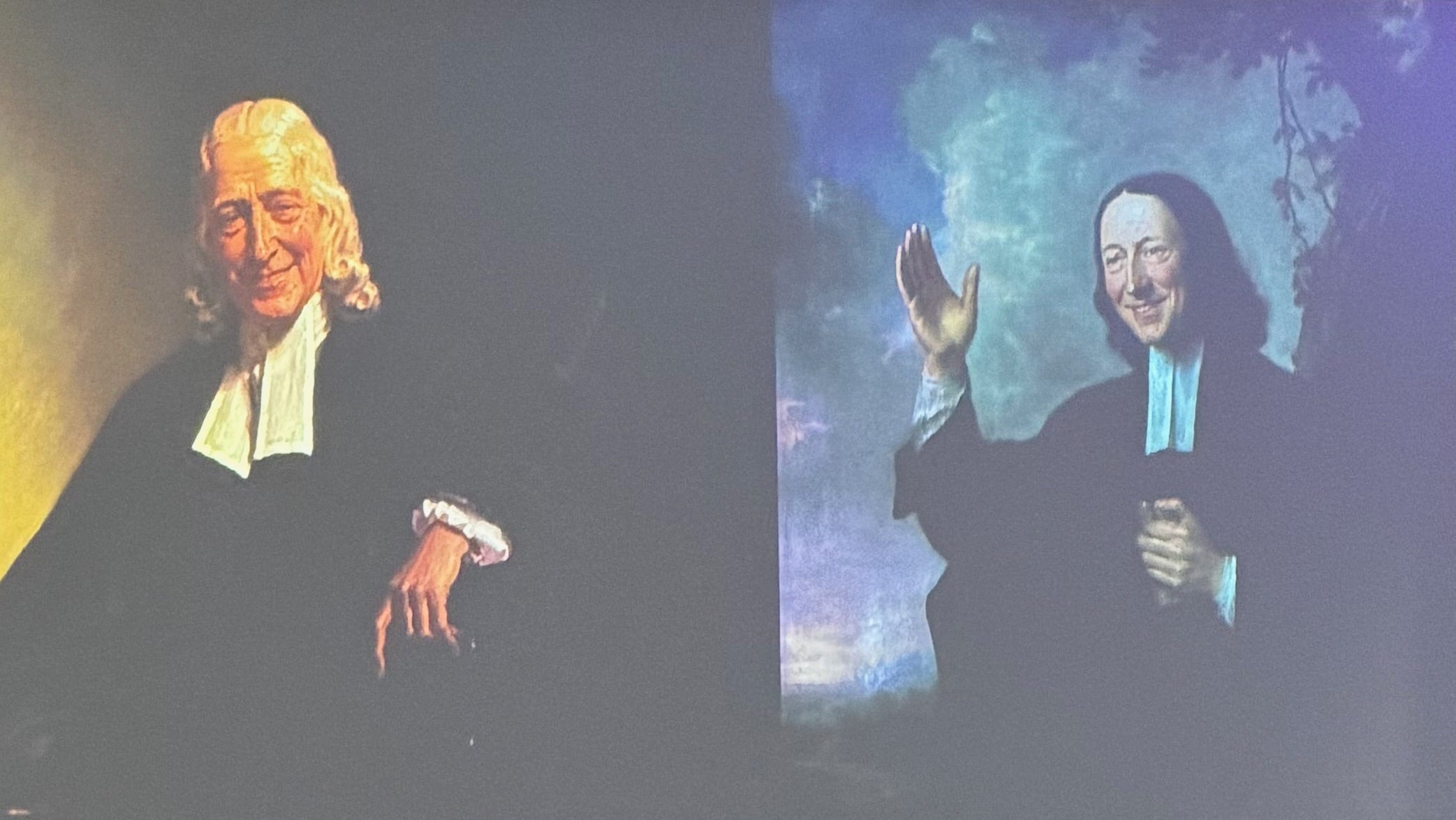
What came next was the part I needed to hear. Wesley’s joy did not arrive through more private effort or a better mood. It came alive in 1739, when he went out to the fields and preached to miners and the poor, and his journal began to fill less with introspection and more with other people moving from fear toward love. The joy was grown into, in the serving, not summoned on command. On a day I was not feeling much of it, that was a more honest word than any pep talk would have been.
What Held
The whole conference shared communion. A missionary, Charles McKinzie, was commissioned and sent toward Geneva, and a baptism followed right after. We honored a class of retirees, decades of ministry carried between them. Thirteen churches were closed too. We read the name of each one, and people connected to it stood as it was named. We prayed, and then voted on all of them together.
Throughout the day I was among friends and colleagues, people doing this same work in their own mission fields. None of us makes the journey alone. Together we keep going, through the glad moments and the heavy ones, with more still ahead. Maybe that is how joy is grown into, over time, in the work we share and the company we keep.